The Builder's Rebellion

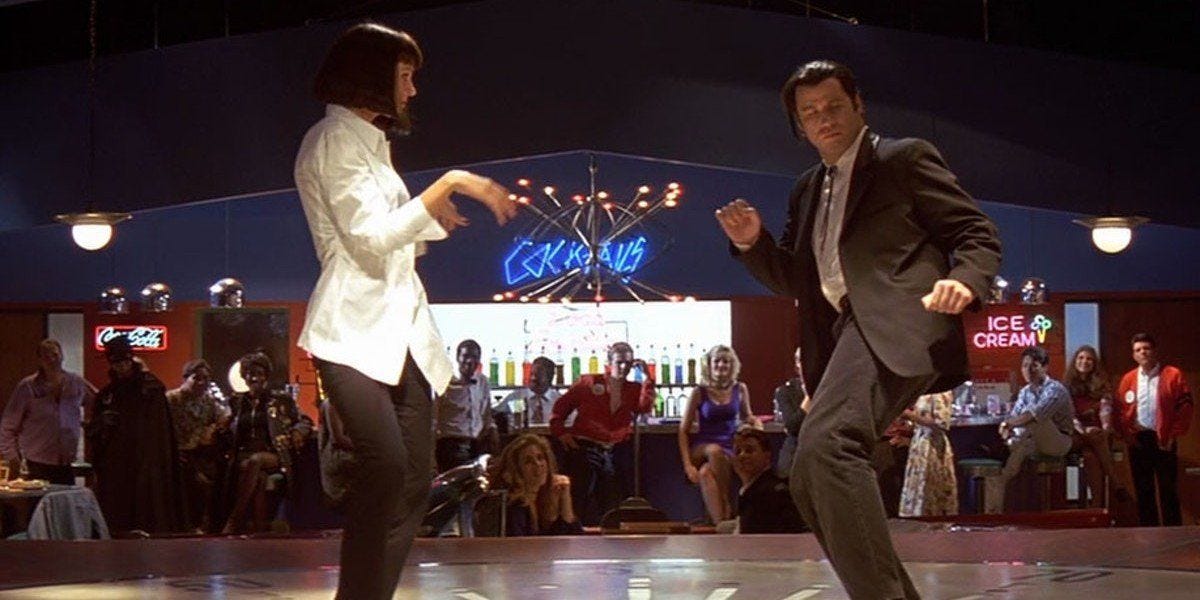
“You know what they call a Quarter Pounder with Cheese in Paris?...A Royale with Cheese.”
--Vincent Vega, Pulp Fiction
Quentin Tarrantino has spent a lifetime studying cinematic history. With Pulp Fiction, he blows it up and rewrites the cinematic rule book.
He places scenes out of chronological order, a puzzle for viewers to solve. He mixes highbrow with lowbrow, crime fiction with art-house filmmaking.
Rather than focus on action, he features lengthy dialogue about cheeseburgers, milk shakes, premium coffee and television pilots.
Great builders defy convention. They surprise us.
Chuck Berry knew blues and country inside and out. Then he used them to invent something entirely new and change the world.
Bob Dylan studied folk music. Then he reinvented it, initially antagonizing loyal fans.
The Replacements merged classic rock with punk, mixing sentimental ballads with hard-edged songs. They helped spawn a new genre called indie rock.
Steve Jobs defied a common understanding of what a phone could be. Jeff Bezos defied a common understanding of what retail could be. Pixar defied a common understanding of what animation could be.
The greatest builders disrupt common understanding of what’s possible. They show restless curiosity for what could be. They operate on long time horizons and bolder visions.
In their quest, they’re misunderstood. They get booed onstage. They’re shunned by mainstream listeners. But inevitably they stretch us, challenge us and make our world better.
This is the builders’ rebellion.
Walking the Razor’s Edge
Well, I’m livin’ in a foreign country, but I’m bound to cross the line
Beauty walks a razor’s edge, someday I’ll make it mine
If I could only turn back the clock to when God and her were born
“Come in,” she said
“I’ll give you shelter from the storm”
--Bob Dylan, Shelter from the Storm
Perhaps no musical artist embodies this restless curiosity and rebellious spirit more than Bob Dylan. Dylan continually defies fan expectations, reinvents himself and redefines what rock and popular music can be.
The story of Dylan’s career is a story of reinvention.
Dylan started by redefining what protest music could be. He built on the tradition created by Woody Guthrie, Pete Seeger and others. Dylan expanded the boundaries.
He made folk and protest music literary and ambiguous. And then, just as he became the bold new face of folk music, he changed course.
He defied fans and the genre by embracing electric rock, an unpopular move with many of his most devoted fans. He was booed at the Newport Folk Festival.
No artist had mixed Chuck Berry’s four chord electric form with long-form literary and poetic lyrics the way Dylan did. He inspired artists ranging from the Beatles to Jimi Hendrix.
And then, as he’s done throughout his career, Dylan reinvented himself again.
With Blood on the Tracks, the opaque, enigmatic artist sang deeply personal love songs about his failed marriage.
Widely considered a masterpiece, the album blends raw emotional honesty with nonlinear storytelling shaped by Dylan’s study of painting. It creates a timeless portrait of love, memory, and loss.
Changes
Still don’t know what I was waiting for
And my time was running wild, a million dead-end streets and
Every time I thought I’d got it made
It seemed the taste was not so sweet
--David Bowie, Changes
Alongside Dylan, there may not be another rock artist who reinvented himself and his music more restlessly and more fruitfully than David Bowie.
Bowie didn’t just evolve his sound. He rebuilt his identity repeatedly. Ziggy Stardust. Aladdin Sane. The Thin White Duke. Each persona wasn’t a phase. It was a creative experiment, a new lens for what rock music could express.
Bowie refused to be pinned down by genre, audience expectation or even his own success. When Ziggy Stardust made him a global star, he abandoned it. When his polished pop peaked in the early ‘80s, he pivoted again.
His Berlin Trilogy—Low, “Heroes,” and Lodger—pushed rock into something colder, more electronic, more atmospheric. It was disorienting to fans expecting hits. But like Dylan going electric, Bowie wasn’t interested in repeating what worked. He was interested in discovering what came next.
The greatest builders rebel against the constraints of their form. Bowie showed that reinvention isn’t a reaction. It’s a discipline. A willingness to let go of what works to find what’s true.
The Builder’s Rebellion
Great builders don’t just master a category. They redefine it.
They study what came before, deeply, obsessively. Then they break it apart and recombine it in ways that feel wrong, until they feel inevitable.
Dylan alienates his fans. Bowie abandons his personas. Tarantino fractures storytelling. The Replacements blur polish and chaos.
In the moment, it feels like a mistake. In hindsight, it looks like vision.
This is the builder’s rebellion. A refusal to stay still. A commitment to curiosity over comfort. The courage to trade short-term approval for long-term impact.
The question isn’t whether the path will be understood. It’s whether it expands what’s possible.
Agree. And personal life is a similar challenge. Rebelling against the expected for what seems to make more sense and then going for it. In my generation it was fighting discrimination, embracing the African American, supporting the gay generation, and so much more. And watching the world catch up with you was rewarding.