The Builders’ Courage
Hendrix. Springsteen. Mitchell. Cobain.

“Well, I stand up next to a mountain
And I chop it down with the edge of my hand”
— Jimi Hendrix, Voodoo Child (Slight Return)
Jimi Hendrix’s Voodoo Chile (Slight Return) is the most poetic distillation of rock ever recorded.
It sounds like the Blues apocalypse, like Robert Johnson and Muddy Waters amplified and distorted through wah-wah pedal and Marshall amps.
To hear or see Hendrix perform it is to witness true greatness, to see a builder at the peak of their craft.
Like all great builders, Hendrix did not arrive overnight.
He studied blues icons like B.B. King, Albert King and Muddy Waters. He worked for years as a sideman for the Isley Brothers and Little Richard. He explored the boundaries of technology, be it Wah-wah and fuzz pedals or his beloved Olympic White Stratocaster.
Hendrix’s impact on his peers and future guitarists is inestimable. You hear it in everyone from Eric Clapton to Jack White to Pearl Jam. His mix of obsessive guitar craftsmanship, bold experimentation and showmanship has never been repeated.
Hendrix embodies the courage of great builders.
He crossed musical boundaries by mixing blues, rock, funk and psychedelia. He crossed cultural boundaries as a black guitarist playing with a white band. He exploded the boundaries of what an electric guitar could do.
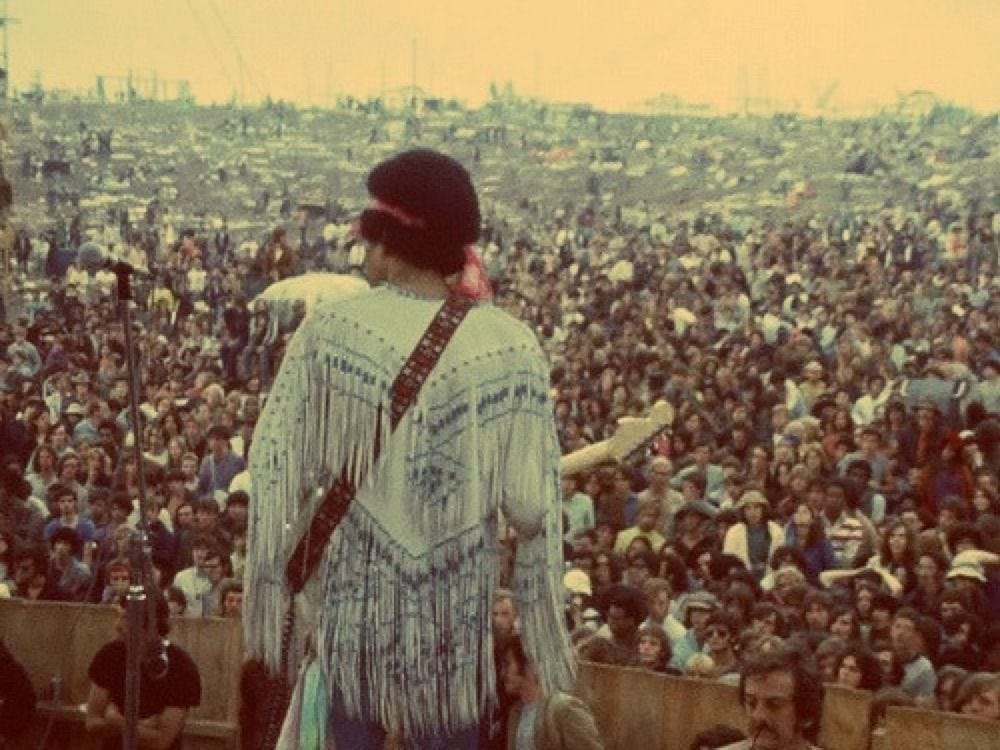
Perhaps his most courageous moment came at Woodstock in August,1969.
It was a time of war, protest and national unrest. Mid-set, Hendrix introduces an unexpected and risky choice, the national anthem. He begins with a straight rendition of the melody, then starts stretching notes, bending the pitch and unleashing sheets of feedback.
Great builders like Hendrix don’t just have skill. They choose a form of courage and push it until it reshapes their medium. Hendrix redefined the system from the inside.
A builder crosses boundaries others accept as fixed.
Born to Run
Oh, someday, girl, I don’t know when
We’re gonna get to that place where we really wanna go
And we’ll walk in the sun
But ‘til then, tramps like us
Baby, we were born to run
--Bruce Springsteen, Born to Run
The recording of Born to Run felt like a last chance.
Despite critical acclaim, Bruce Springsteen had not achieved mainstream success. He had not fully expressed the sound in his head. His label was ready to drop him.
In a sense, it was a last stand for rock music as well. Much of rock had become corporate, slick and polished. Disco dominated. Like Springsteen, it was in a dire moment.
Springsteen had a dream. He wanted to tell stories of the American working class in a way that was cinematic, mythical and emotional. He wanted to give voice to the voiceless. For eighteen months, he pushed himself and his band to their limit.
Springsteen’s courage and commitment to his vision paid off.
Born to Run revitalized rock and roll and transformed Springsteen’s career. It reset rock’s expectations and ambitions. Springsteen showed that rock was still a powerful vehicle for emotion and storytelling.
Like the greatest builders, Springsteen doubled down on his craft and held firm to his vision, even with his back against the wall. He not only saved his career but revitalized rock and roll’s soul.
Like Hendrix, he showed a builder’s courage. Springsteen went all-in when retreat was the safer option.
A builder bets everything on a vision before the world believes in it.
Blue
Oh, I am a lonely painter
I live in a box of paints
I’m frightened by the devil
And I’m drawn to those ones that ain’t afraid
--Joni Mitchell, A Case of You
Joni Mitchell’s courage was to strip away the artifice and remove the safety net. Just a dulcimer, a melody and voice.
This most sophisticated artist achieved one of her greatest moments, the album Blue, with a stripped-down approach. It’s one of the most honest, vulnerable and unadorned albums ever recorded.
Mitchell gave future artists permission to tell their story simply and directly and share their deepest truths. She inspired future artists ranging from Prince to Bon Iver to Taylor Swift.
A builder removes everything that hides the truth.
Nevermind
With the lights out, it’s less dangerous
Here we are now, entertain us
I feel stupid and contagious
Here we are now, entertain us
--Nirvana, Smells Like Teen Spirit
I was sitting in a small apartment in Arlington, Virginia with my girlfriend (now wife) when I heard it. The opening song was unlike anything I’d heard.
The sound was messy, chaotic and primitive. The words were wounded, vulnerable, sarcastic and confused. The singer sounded conflicted, overwhelmed, furious and scared.
It was the fury of Hendrix mixed with the vulnerability of Mitchell.
Cobain’s courage was to reject polish entirely.
Imperfection became admirable. Confusion became acceptable. Vulnerability became a strength. Flannel replaced glam. Distortion replaced polish.
In an instant, Nirvana changed the emotional center of rock music. He stripped the system to its raw elements and started over.
Artists were encouraged to put authenticity and truth ahead of polish. They were emboldened to give voice to vulnerability. They were freed to experiment with sound and structure.
A builder rejects the system when it no longer feels real.
What looks like genius is often courage aligned with clear purpose. Hendrix crossed boundaries. Springsteen bet everything. Mitchell told the truth. Cobain rejected the system.
This is what the greatest builders always do.