Be Curious
What I learned from Ted Lasso

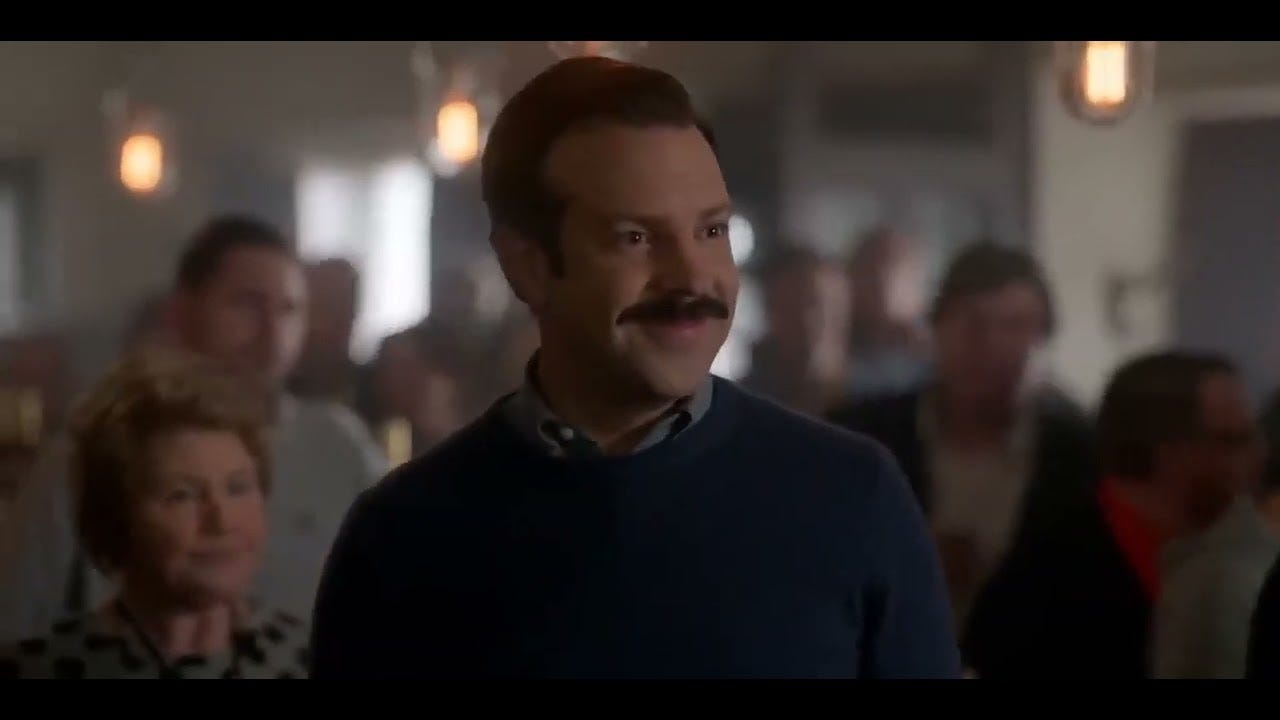
You know, Rupert, guys have underestimated me my entire life. And for years, I never understood why. It used to really bother me. But then one day, I was driving my little boy to school and I saw this quote by Walt Whitman, and it was painted on the wall there. It said:
“Be curious, not judgmental.”
--Ted Lasso
This quote is from one of my all-time favorite scenes in one of my favorite shows, Ted Lasso. It celebrates ideas I believe in deeply as a leader.
For one, I love the main character, Ted Lasso.
For another, I love the poet he quotes, Walt Whitman, whose writing expresses freedom, unity and the dignity of the individual.
In addition, I love curiosity, which I believe is a deeply undervalued super-power in work and life.
Further, I love stories of underdogs who are underestimated and defy the odds.
Most of all, I love the themes embodied in Lasso’s unassuming, folksy anti-hero character. Kindness. Optimism. Empathy. Curiosity.
In the scene quoted above, Lasso engages in a darts contest with the powerful billionaire Rupert Manion. Rupert arrogantly assumes, based on Lasso’s affable, self-deprecating nature, that he will easily beat him.
Lasso smiles, and as he makes perfect throw after perfect throw with quiet confidence, he offers the defining monologue of the series. Lasso goes on to say:
All them fellas that used to belittle me, not a single one of them were curious. You know, they thought they had everything all figured out. So they judged everything, and they judged everyone. And I realized that their underestimating me... who I was had nothing to do with it. ‘Cause if they were curious, they would’ve asked questions. You know? Like, “Have you played a lot of darts, Ted?”
As he hits the final bullseye to win his bet with Manion, he concludes:
To which I would’ve answered, “Yes, sir. Every Sunday afternoon at a sports bar with my father, from age 10 until I was 16 when he passed away.”
If you haven’t watched the series, I encourage you to do so. On the surface, Ted Lasso is an entertaining show about an improbable coach elevating a professional soccer team to their highest potential.
But, more importantly, Ted Lasso is a powerful story about leadership and our better selves. Here is how it inspired me as a leader.
Believe
We choose to go to the Moon in this decade and do the other things, not because they are easy, but because they are hard; because that goal will serve to organize and measure the best of our energies and skills, because that challenge is one that we are willing to accept, one we are unwilling to postpone, and one we intend to win, and the others, too.
-John F Kennedy Jr.
In his now famous “Moonshot” speech at Rice University in 1961, JFK called on Americans to believe in something bigger than themselves.
JFK’s goal of landing on the moon demanded that the American public believe in an ambition that seemed nearly impossible. The technology didn’t exist. The timeline was ambitious. Yet JFK asked the nation to believe.
Kennedy’s vision was achieved eight years later when astronaut Neil Armstrong took the first step on the moon. Kennedy challenged Americans and asked them to believe, and they did.
This is what great leaders do.
Martin Luther King Jr. inspired people to believe in justice, equality and the moral power of love. Nelson Mandela inspired people to believe in freedom and unity for South Africa. Winston Churchill inspired England, in its darkest moments, to believe they could overcome Hitler.
Similarly, Ted Lasso made “Believe” a meme. One of Lasso’s first moves in leading AFC Richmond is to handwrite a yellow “Believe” sign and tape it above the coaches’ office.
Lasso uses “Believe” to turn a broken, skeptical team into a group grounded in hope, trust, and purpose. It becomes a symbol for what people can achieve when they choose optimism over fear, connection over isolation, and heart over cynicism.
Great leaders inspire people to believe in something bold, inspiring and bigger than themselves.
Be a Goldfish
All the hardships that I had to go through early in my career were lessons learned. That’s all I use them for. I didn’t let them knock me down. I just kind of created a version of myself where I was just going to continue to adapt.
--US Olympic Goalie Connor Hellebuyck
Connor Hellebuyck stopped a remarkable forty-one shots to help the US beat Canada for the gold medal. But the Olympic hero had a long path to Olympic Gold. He was undrafted out of high school. He was benched in his first college game. He had horribly disappointing performances playing in the NHL playoffs.
But Hellebuyck kept picking himself up. He treated failures as useful data. He kept learning. He never stopped believing in himself.
Hellebuyck explained his mindset simply: “Constantly going and being an underdog and just making it work, persevering and getting through.”
In Ted Lasso’s words, Hellebuyck was a goldfish.
There’s a moment early in Ted Lasso when one of the players, Sam Obisanya, is beating himself up after making a mistake on the pitch. He’s frustrated, embarrassed, and replaying the error in his mind.
Lasso walks over and asks: “You know what the happiest animal on earth is?”
Sam shakes his head. Ted explains:
“It’s a goldfish. You know why? ’Cause it’s got a 10‑second memory.”
Then he pats Sam on the shoulder and says: “Be a goldfish.”
Great leaders hold people up, especially in difficult moments. They help people overcome failure, learn from adversity and move forward. They know when to bring levity and when to be serious.
On the surface, the Ted Lasso series is about an amiable small-time American coach who improbably leads a scrappy British soccer team to victory. But really, it’s a story about leadership.
Lasso’s message is simple.
Be inquisitive, not judgmental, and encourage others to do the same. Inspire people to believe in audacious, inspiring goals. Help people overcome setbacks and use data to learn and grow.
Be curious. Believe. Be a goldfish.
n A League of Their Own (1992), Tom Hanks' character, team manager Jimmy Dugan, famously tells Geena Davis's character, star catcher Dottie Hinson, who is about to quit their baseball team: "It's supposed to be hard. If it wasn't hard, everyone would do it. The hard is what makes it great". This scene encourages her to push through challenges.